
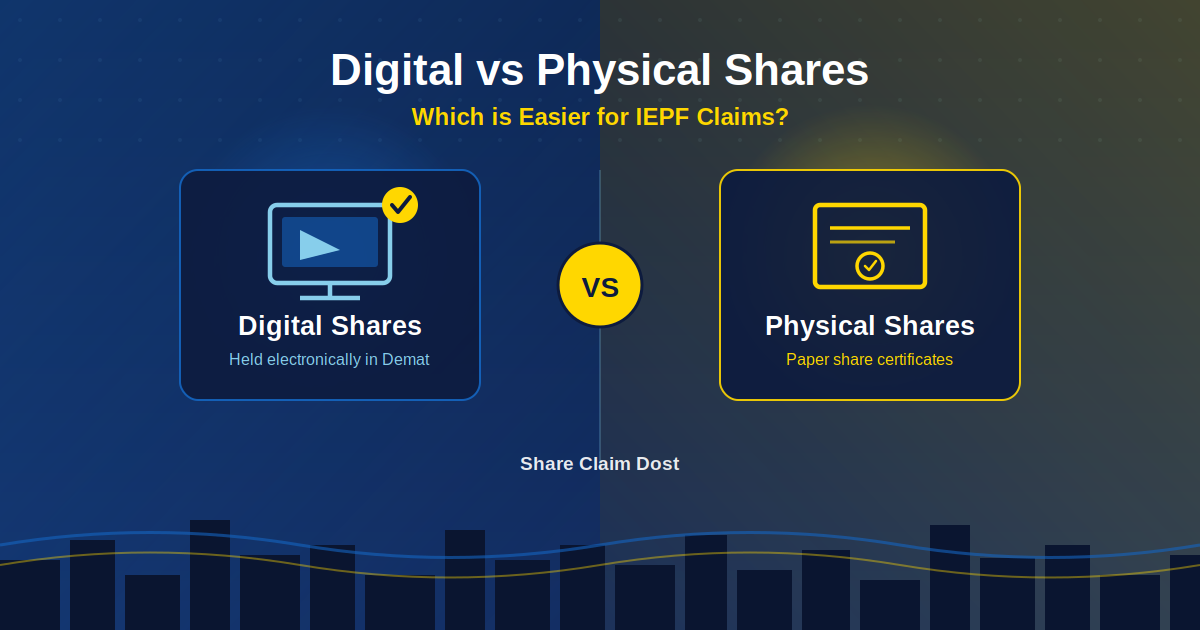
Which is easier for making claims to the IEPF—digital or physical shares?
Many investors are unsure whether it is easier to claim shares that are held in Demat form than those that are held in the form of physical share certificates when recovering unclaimed shares that have been transferred to the Investor Education and Protection Fund (IEPF).
The straightforward answer is that digital shares are usually easier to manage, but the difficulty of making a claim through an IEPF depends on factors other than the format of the shares.
All the things that have to do with your ownership, the documents you have, your position as a shareholder, the requirements relating to legal heirs, and the history of the investment may affect the claim process.
In this article, let us look at the difference between digital and physical shares and examine how each of them can impact an IEPF claim.
What are digital shares?
Digital shares, which are generally referred to as **Demat shares**, are securities that are held electronically in a Demat account by means of a Depository Participant (DP), for example a bank or stockbroker.
Rather than retaining a physical certificate, ownership is kept in electronic form.
### Advantages of Digital Shares
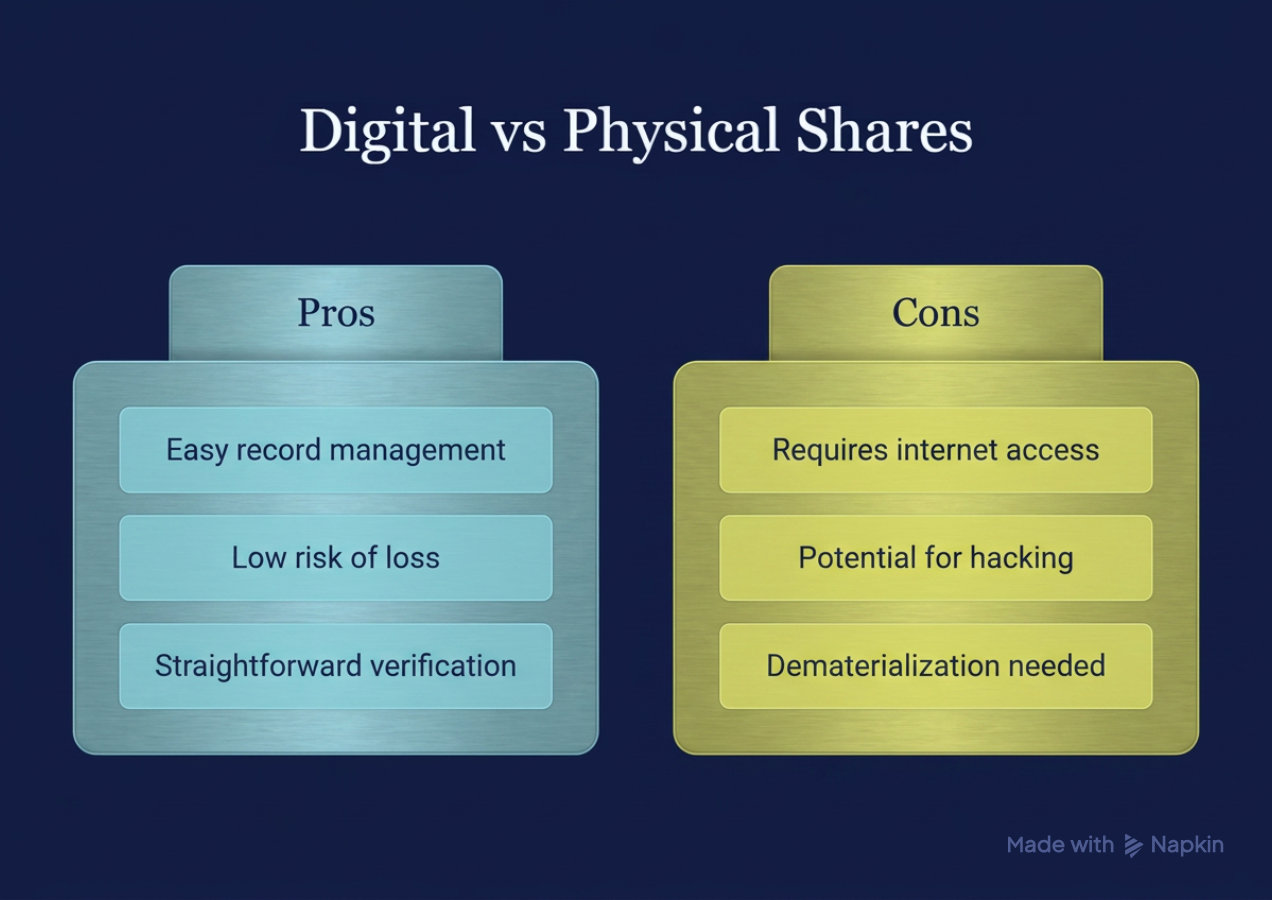
* Easy to track and manage * No risk of losing a physical certificate * Electronic ownership records * Easier transfer of securities * Convenient portfolio management * Reduced paperwork for routine transactions
Since records are kept in electronic form, it is generally easier for investors to keep an eye on and maintain their Demat holdings.
---
What are physical shares?
Physical shares are shown by **paper share certificates which are issued by companies**.
Old share certificates bought decades ago are still to be found in many Indian families. They might have been forgotten in cupboards or files or could have been inherited from parents or grandparents.
Even though physical shares are now less common, an old certificate can still stand for a valuable investment.
On the other hand, trouble may arise when the shareholder's information is out of date or when the original shareholder has died.
---
What occurs when shares are transferred to the IEPF?
According to the relevant rules, the shares can be transferred to IEPF if dividends have remained unclaimed for the specified period, provided that the applicable requirements are met.
After the shares have been transferred to IEPF, the eligible investor or claimant should adhere to the specified procedure in order to claim them.
The process usually consists of determining the investment, establishing the claimant's right to it, preparing the necessary documents, and then carrying out the relevant claim and verification procedure.
The type in which the shares were originally held—whether it was digitally or physically—can have an effect on the documentation required.
---
## Digital vs Physical Shares for IEPF Claims
Why are digital shares usually easier?
Demat shares have a important advantage which is electronic records.
There is no need for investors to worry about losing, having their certificates damaged, or being responsible for storing them; in addition, it is simpler to keep records of the investment via a Demat account and to maintain up-to-date records.
It does not follow that an IEPF claim will be easy simply because the shares were held in electronic form.
The person making the claim still has to prove that they are entitled to it and have to submit the documents needed for that particular claim.
Demat shares do reduce certain documentation problems, but they do not get rid of the IEPF claim process.
---
Why are physical shares more difficult?
Old physical share certificates can create complications when:
* The shareholder's address has changed * The shareholder's name has changed * The original shareholder has passed away * The certificate is damaged or missing * Signature records need verification * Multiple legal heirs are involved * Company or shareholder records contain discrepancies * The company has undergone a merger, name change, split, or other corporate action
Before the investment can be recovered, further verification and documentation may be needed.
---
What if the shareholder has died?
It is one of the most common cases concerning old shares and IEPF claims.
Where the original shareholder has died, the legal heir or another eligible claimant might be required to prove their legal right to the investment.
In certain situations it may be necessary to provide documents concerning the death of the shareholder, succession, nomination, the legal heirs, transmission, or any other relevant requirements.
The process can become more complicated when:
* There are multiple legal heirs * The shareholder left no clear nomination * Documents contain different names or addresses * The original certificates cannot be located * Family members disagree about the investment
In the case of inherited investments, the legal status of the person making the claim is more significant than the fact that the shares are digital or physical.
---
What concerning the old physical share certificates?
Do not suppose that an old share certificate found at home has no value.
An old investment may have been affected by corporate actions such as:
* Bonus issues * Stock splits * Mergers * Company name changes * Other corporate restructuring
The number of shares indicated on an old certificate therefore probably does not show the full amount of the investment connected with that holding at present.
That is the reason why old certificates should be properly verified before they are thrown away.
---
Is it necessary to dematerialise physical shares?
Whether or not physical shares have to go through dematerialization will depend on the specific circumstances and on the relevant requirements.
The process of dematerialization turns eligible physical securities into electronic form.
It would be a mistake for investors to suppose that converting an old certificate into Demat form automatically fulfils an IEPF claim.
The investment will first have to be properly identified, ownership set up, and the relevant IEPF and company/RTA procedures adhered to.
---
So, which is easier when it comes to making an IEPF claim?
### Digital Shares Generally Have an Advantage
Digital shares are usually easier to manage than physical shares when all the details about ownership are clear and the necessary documents are available.
But the difficulty of an IEPF claim depends on several factors:
1. Was the original shareholder alive? 2. Who is putting forward the claim? 3. Is it correct that the shareholder details are given? 4. Have the ownership records been made available? 5. Have the necessary documents been completed? 6. Is there any involvement of the legal heirs? 7. Can I get a physical certificate? 8. Has the company experienced any corporate changes?
It is wrong to state that all Demat claims are easy or that all physical-share claims are difficult.
---
## How Shares Claim Dost Can Help
The process of recovering such things as old physical share certificates, unclaimed dividends, investments that have been forgotten, or shares which have been transferred to IEPF can at times seem complicated.
The service **Shares Claim Dost** enables investors and families to understand and cope with the share-recovery and IEPF claim process.
Our assistance can be useful for cases involving:
* IEPF-transferred shares * Unclaimed dividends * Old physical share certificates * Deceased shareholders * Legal-heir claims * Share transmission * Dematerialization-related requirements * Forgotten or outdated investment records
The aim is to make it easier for people to understand the process and to help the claimants arrange the documentation and follow the procedures.
---
## Final Takeaway
Digital shares are usually simpler to manage than physical shares since the electronic records cut down on the chances of certificates being lost and make keeping records easier.
The ease of filing an IEPF claim is determined by the full range of circumstances surrounding the investment.
Do not assume that the investment has been lost if you or your family have an old share certificate, a forgotten investment, or shares which may have been transferred to IEPF.
The first step is to identify the investment and then look at the appropriate records. If you aren't sure about how to proceed with the claim, seeking professional assistance will help you to understand what comes next.
Do you have old shares or an IEPF claim?
Dost's Shares can help you to understand the recovery process.
🌐 **Visit:** sharesclaimdost.com
This article is for general investor awareness and provides information only. The claim requirements of the IEPF may differ according to individual circumstances and the relevant regulations. It is essential that you check the most up-to-date requirements with the relevant company, the Registrar and Transfer Agent (RTA), the IEPF authorities, and all other applicable sources before making a claim.

 +91 8000887994