
Not long ago, a caller told us something we've heard many times before:
"I found some old share papers at home. They're probably useless now, right?"
The interesting part is that he wasn't asking about a few documents. He was talking about investments his family had completely forgotten about.
That's often how share recovery begins.
Someone is cleaning out an old cupboard, sorting through family files, or handling paperwork after a parent's retirement. Among the documents, they come across share certificates, dividend warrants, or investment records they haven't seen in years.
At first, it feels like a lucky discovery.
Then the questions start.
Are these shares still active? Has the company changed its name? What happens if the original shareholder has passed away? And perhaps the biggest question of all—can the shares still be claimed?
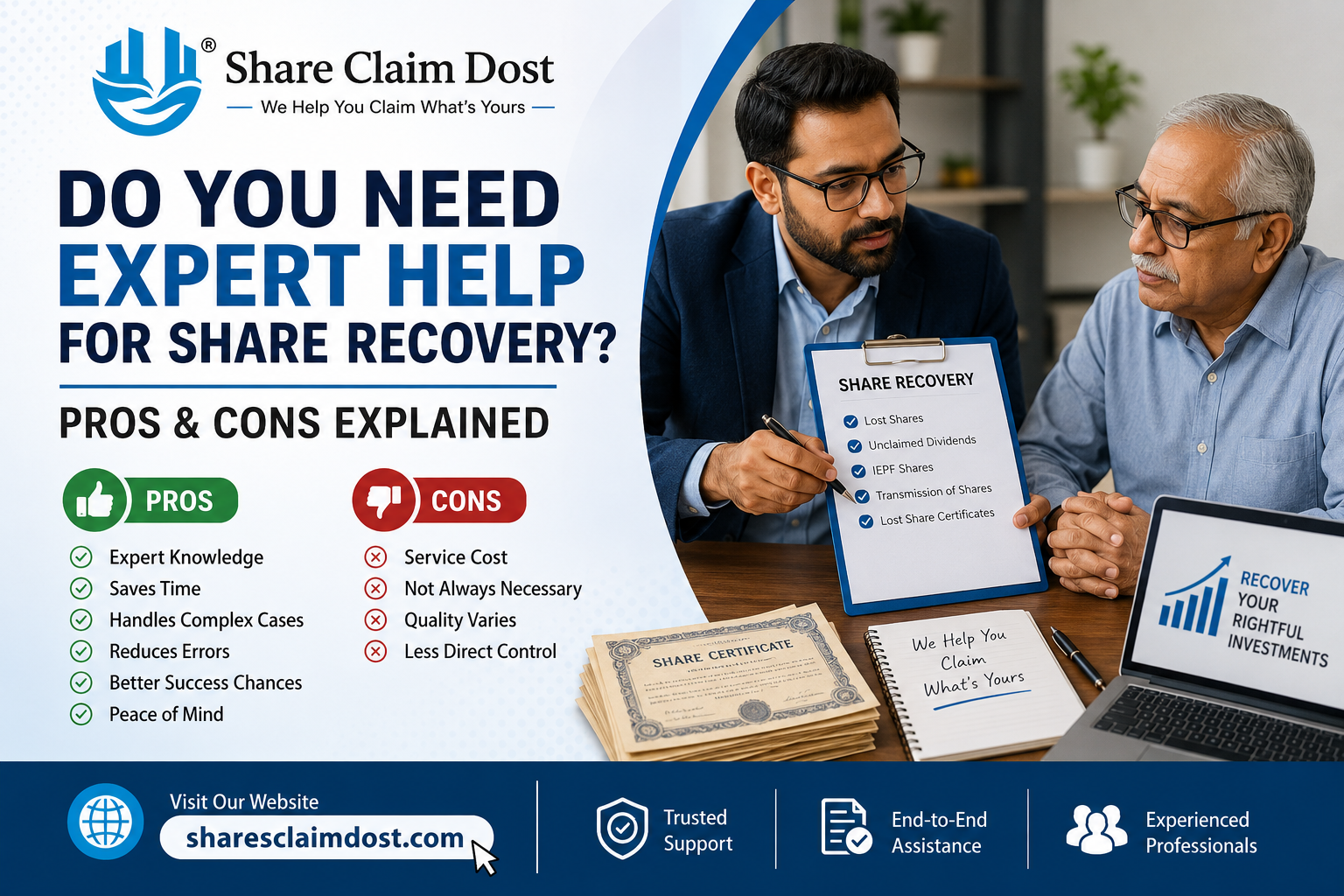
Many investors reach a point where they're unsure whether to continue on their own or seek professional help.
The answer depends less on the value of the shares and more on the complexity of the situation.
I've seen cases where the recovery process was relatively straightforward. The documents were available, the records matched, and the investor simply needed to complete a few formalities.
I've also seen situations where one missing document created weeks of back-and-forth communication.
That's why the decision isn't really about whether experts are good or bad. It's about understanding what you're dealing with.
Take a simple example.
Suppose you have the original documents, your name matches the records, and the shares are easy to identify. In a case like that, you may feel comfortable handling the process yourself. It will take some effort, but it isn't necessarily complicated.
Now imagine a different scenario.
The shares belonged to your father. The certificates are decades old. The company has undergone changes over the years. Some dividends were never claimed. The investment may even have been transferred to the IEPF.
Suddenly, the process looks very different.
This is usually where professional assistance becomes valuable—not because the investor is incapable of handling the matter, but because the paperwork and procedures become harder to navigate.
One benefit people rarely talk about is confidence.
When you're dealing with old investments, uncertainty can be more frustrating than the paperwork itself. You're constantly wondering whether you've filled out the correct form, attached the correct documents, or missed an important step.
An experienced professional can't eliminate every challenge, but they can often tell you what to expect and what to prepare for.
Of course, there is another side to the discussion.
Professional help costs money.
And if your case is straightforward, paying a service fee may not make much sense. Some investors are perfectly capable of managing the process independently, especially when the records are complete and the requirements are clear.
That's why there isn't a single answer that applies to everyone.
If your case is simple, handling it yourself may be the most practical option.
If you're facing missing records, legal heir issues, lost certificates, or IEPF-related complications, getting guidance from someone who regularly works on such matters can save a significant amount of time and frustration.
In the end, the real question isn't whether you need an expert.
The better question is: how complicated is your case?
Once you answer that honestly, the right decision often becomes much clearer.

 +91 8000887994